

Hiring someone to build your business website can be a huge investment of time and money and to the untrained eye, it may be hard to tell them apart or determine why they can appear so different on the surface. Here I’ll break down the current state of web design and how different players in the market may hold different skillsets and biases.
There is an abundance of options for creating a website in 2026. There is an established myriad of intuitive web builders like Wix and Squarespace, several AI-generated options by Loveable or ChatGPT, and then there is the more traditional web designer. I want to unpack the different types of web designers you may encounter out in the wild.
Present day technologies have completely blurred the lines of what a web designer is, and depending on which one of those personas is driving the ship, can yield output that is very different in quality. So I want to classify the different types of “web designers” on the market and which skillsets might be a fit for your project.
The Players
True Web Developers or software engineers are still your best bet for building complex, dynamic websites and applications, when data and security are a top priority, if you plan to collect and store customer information, if you need to display multiple products for e-commerce and handling online payments. With today’s technology they have inched toward “good design” using standardized user interface libraries like Material Design and Apple Human Interface Guidelines (HIG).
Graphic Designers create a rich visual layer that can convey a strong identity and story. They leverage basic design principles such as hierarchy, scale, emphasis, repetition, contrast, and proximity to create a composition and evoke an emotion or tone. While it is only superficial, it can be the key differentiator in some verticals where products are otherwise the same. While some of these skills overlap with a web designer, they generally stop at the technical level.
Web Designers or User Interface Designers (UI) bring a few more colors to the rainbow. Like graphic designers they apply design principles to visual elements such as typography, color, imagery, video and motion to communicate services, branding and storytelling. They also understand how front-end technologies like HTML and CSS work so that the design elements they choose can be properly implemented for different form factors like desktop and mobile. They research SEO keywords for technical and on-page SEO, which then informs the site architecture and content strategy.
UI/UX Designers have all the skills of the web designer above, but also account for the end user’s journey as a whole. Their expertise is in addressing the same customer at different points in their journey. For example, a brand new customer might need more education on a given topic or be persuaded by social proof and credentials to move forward. That same customer, at a later time, may be ready to buy and be interested in understanding your processes, specific trade products, warranties, and pricing. In practice, this might come in the form of different pages being created for each flow or different user interface components utilized to store added context at the right time.
SEO specialists have emerged as a dedicated discipline, and for good reason — search ranking has become increasingly competitive. A good SEO specialist understands that about half the strategy lives inside the website itself: keyword research, technical SEO, page structure, mobile optimization, and local signals. The other half is external: backlinks, Google Reviews, and other off-site sources that build your authority and credibility over time. Where they fit in your project depends on scope — a web designer with solid SEO fundamentals may cover the on-site half well, while a dedicated SEO specialist makes more sense if ongoing ranking and off-site strategy are a priority.
The AI-Assisted Builder is the newest archetype on the scene. Using AI prompting and sample references, a brand new experience can be spun up with very little effort. The output can vary greatly depending on the input, the quality assurance practices, and the general awareness of best practices and domain knowledge.
It’s worth noting that larger agencies that offer web design might have enough staff to cover all the disciplines above, but even then, results come down to leadership, processes, culture and each individual’s skills in the chain.
So Who Do You Pick?
Every small-sized agency is going to have a limited range of one or two core strengths, with some adjacent capabilities to a lesser degree. It’s a matter of being clear on what core skill you require most. My rule of thumb is, look at an agency’s past work as a predictor of what to expect your work to look like. It is a solid heuristic of that agency’s standard for success, capability and potential blind spots. If the work portfolio looks amateur, sloppy or shows any other shortcomings, that is a red flag that your standards are misaligned. You’ll want to view live sites, to evaluate load times at pagespeed.web.dev, working links, consistency throughout and accessibility score using wave.webaim.org. This is a good proxy for how search engines will rank the site — and yours. If an agency has no work to show at all, this is a huge, seen-from-Mars red flag.
For a more practical example, say you’re opening a cool coffee shop and want to cater to a specific demographic — then a web designer with a strong branding portfolio that can give your shop a specific vibe is a good start. Designer’s execution can vary vastly, so choose one whose work you already like, or if you have something specific in mind, show them a sample as it will cut down on the iteration cycle.
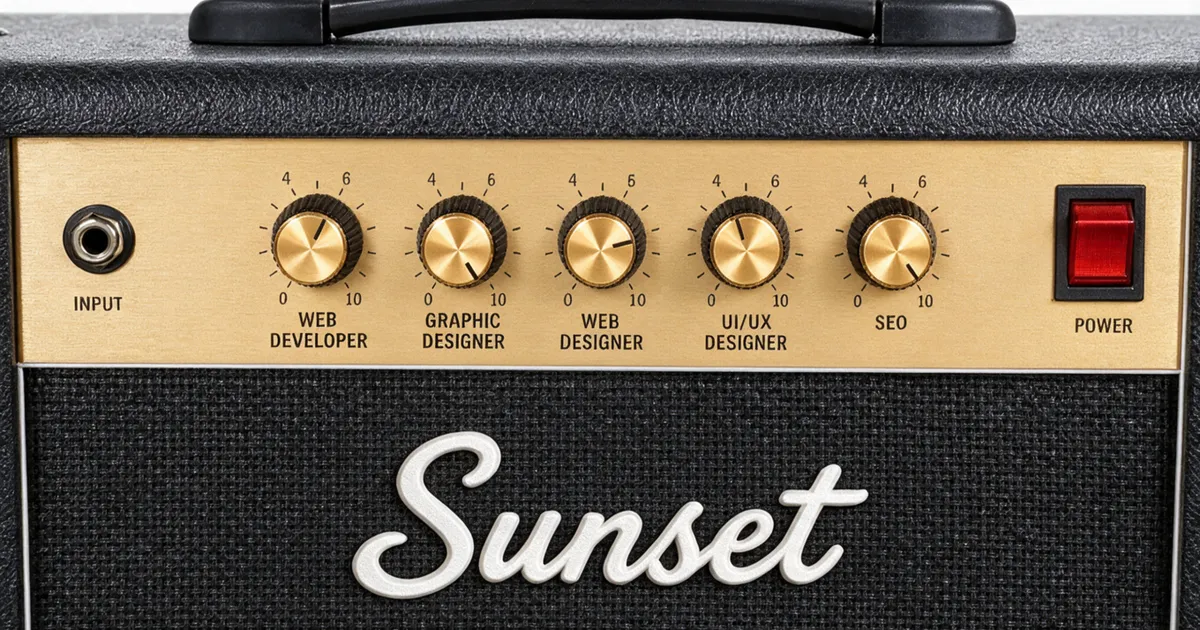
Taking the example further, let’s say in addition to this you want a website that customers can buy coffee with multiple SKUs and merch or multiple locations — then you’ll want to look for an agency with a stronger developer arm. Think of it like tuning the knobs on a speaker — turn up the attributes you want to amplify most, and dial-down less relevant ones. Also, realize that in this example you could source your creative direction and branding from a single graphic specialist and then find a separate agency to handle your technical needs.
Process
In either case, you’ll want to ask for an outline of their process, so you understand the touchpoints you’ll be involved in, iterations, and milestones. You’ll also want to get a detailed proposal of the planned work, scope, timeline and deliverables. Regarding the website, you’ll want to see who handles the copywriting, check if SEO is accounted for, accessibility, hosting, domain. You’ll also want to make sure there is a transfer plan in place for you to own the hosting, domain and code. Lastly, check if any post-launch support or training will be conducted.
The Bottom Line
Choosing the right web designer comes down to knowing what your project actually needs most. If it’s a strong visual identity, lean toward design. If it’s a complex, data-driven application, lean toward engineering. If it’s a local service business that needs to be found and trusted online, a UI designer with solid SEO fundamentals is usually your best starting point. The Players above aren’t a rigid hierarchy — they’re a spectrum. The clearest signal you can give yourself is to look honestly at what’s already working in your market, find the agency whose portfolio reflects the standard you’re aiming for, and ask the right questions before you sign anything.